Apologies for not keeping up this blog. So many things have got in the way, nothing too serious but just didn't get around to updating.
Last year, as mentioned, I completed an online poetry writing course. Grades were great and since then I've been subbing to magazines and competitions, so far without success. Set form, formal poetry has been a special interest - terza rimas, pantoums, sonnets and so on - but these rarely appear in lists or magazines. Successful poets seem currently to be writing lovely but rather ethereal poetry, so I'm wondering if I need to be more like that.
Recently submitted to a single-poem comp and also one for poetry pamphlets - around twenty poems. Waiting and hoping.
Currently I'm studying with an online Art Appreciation course. Not strictly a writing-related thing, but I try to get all the main points in my assignments while giving them a literary sort of style. Really enjoyable but very time-consuming. I've a very long history of published articles and some short stories and flash fiction, but the tutor doesn't know that. He commented, 'Well you can certainly write'! Seven assignments in and marks average 9/10. Find myself watching loads of art programmes on TV and realise I have been watching them keenly for years.
On the subject of our current lockdown, I have been noticing on social media that many of the writers I follow are struggling with moving their projects forward. It has taken them by surprise, as although most work from home and are used to being solitary, the atmosphere isn't now conducive to concentration. I've recently written a short piece on why this is, and how to manage it, and I believe it will be published online sometime soon. People report that it's more difficult to work with family members buzzing around, and concentration is difficult with all the awful media information pouring in. I'll write more on this soon, in case it might be helpful. In the meantime, the parting greeting 'Take care' has been replaced by 'Stay safe'.
Friday 17 April 2020

Saturday 8 June 2019
Tips for writing students working online
After a long break ...
Here's the text of my ten tips for completing an online writing course. The piece was published on the blog of The Writers' Bureau on June 7th, 2019. I had just successfully completed the Bureau's online course, The Art of Writing Poetry, during which quite a portfolio of poems developed, including some set forms as I wrote in the previous post on this blog. My later submissions earned A+ grades, and this spurred me on to try to get my work published - an ongoing uphill task, but as with the course itself, I won't give up.
Some of the points may seem obvious, but surprisingly not all are followed by all students. I've studied through online and postal courses quite a number of times now, almost all writing-related (and all completed) and one for drawing (dumped), but I know what it's like to become disheartened. So here is the piece:
I’ve recently completed the poetry course with The Writers’ Bureau, and found planning helpful in keeping up the momentum. Here are ten suggestions to remain on track from selection to completion. There is so much enjoyment and satisfaction to come!
1 When choosing your course, whether purely for interest or with an aim to be published, read
everything the website can tell you about it. Don’t be put off by a suggested timescale. (I
completed mine with very few weeks to spare.)
2 Pounce on the course materials. Read the introduction and details of the first assignment carefully.
Flicking through the next few modules may whet the appetite.
3 Plan your writing rate and submission goals. For example, a target number of hours per week, to
include reading the course material as well as writing. If there are, say, twelve assignments over
two years, your goal might be to submit every six to seven weeks. But if you can’t keep to this,
never be tempted into ‘that’ll do’. Make it The Best!
4 Keep a notebook with you always, including at night, and jot down ideas, snatches of
conversation (one spawned a prize-winning short story for me!), themes, or issues that upset,
annoy or inspire you.
5 On settling to work, check the notebook. If there’s no light bulb moment, think about an event and
ask ‘what if?’. Start a rough draft and try not to edit as you go along. I found it best to have both
something starting from scratch and one piece in mid-edit.
6 Keep a log of your work; it’s very motivating to see it piling up. For each assignment I kept a
folder with a copy of the submission, the feedback, and the resulting edited version. Keep a note
of submission contents and grades – this will hopefully show progress and be motivating.
7 Examine feedback carefully; if points are repeated, that needs sorting. You may not agree with
every point but each will have a reason. Bask in positive comments.
8 If it’s a struggle, or there’s a troublesome issue, ask the tutor for advice. It can be hard to be
objective about our own work.
9 Expect variable enthusiasm levels! Typical is a burst of creativity followed by a slowdown, then
an increase in energy as you get into the second half of the course. Update friends/family on
progress – that helps avoid temptation to ‘take a break’.
10 If you hope for publication, make notes about target markets as you go. If the course is mainly for
enjoyment, why not build up a catalogue of the work to take pride of place on the bookshelf?
Wishing everyone a fulfilling, successful – and completed – writing course!
Here's the text of my ten tips for completing an online writing course. The piece was published on the blog of The Writers' Bureau on June 7th, 2019. I had just successfully completed the Bureau's online course, The Art of Writing Poetry, during which quite a portfolio of poems developed, including some set forms as I wrote in the previous post on this blog. My later submissions earned A+ grades, and this spurred me on to try to get my work published - an ongoing uphill task, but as with the course itself, I won't give up.
Some of the points may seem obvious, but surprisingly not all are followed by all students. I've studied through online and postal courses quite a number of times now, almost all writing-related (and all completed) and one for drawing (dumped), but I know what it's like to become disheartened. So here is the piece:
See It Through And Reap The Rewards
June 7th, 2019
When you’ve looked at the writing courses on offer and made the commitment, a strategy can be helpful to ensure you’ll get the maximum benefit.I’ve recently completed the poetry course with The Writers’ Bureau, and found planning helpful in keeping up the momentum. Here are ten suggestions to remain on track from selection to completion. There is so much enjoyment and satisfaction to come!
1 When choosing your course, whether purely for interest or with an aim to be published, read
everything the website can tell you about it. Don’t be put off by a suggested timescale. (I
completed mine with very few weeks to spare.)
2 Pounce on the course materials. Read the introduction and details of the first assignment carefully.
Flicking through the next few modules may whet the appetite.
3 Plan your writing rate and submission goals. For example, a target number of hours per week, to
include reading the course material as well as writing. If there are, say, twelve assignments over
two years, your goal might be to submit every six to seven weeks. But if you can’t keep to this,
never be tempted into ‘that’ll do’. Make it The Best!
4 Keep a notebook with you always, including at night, and jot down ideas, snatches of
conversation (one spawned a prize-winning short story for me!), themes, or issues that upset,
annoy or inspire you.
5 On settling to work, check the notebook. If there’s no light bulb moment, think about an event and
ask ‘what if?’. Start a rough draft and try not to edit as you go along. I found it best to have both
something starting from scratch and one piece in mid-edit.
6 Keep a log of your work; it’s very motivating to see it piling up. For each assignment I kept a
folder with a copy of the submission, the feedback, and the resulting edited version. Keep a note
of submission contents and grades – this will hopefully show progress and be motivating.
7 Examine feedback carefully; if points are repeated, that needs sorting. You may not agree with
every point but each will have a reason. Bask in positive comments.
8 If it’s a struggle, or there’s a troublesome issue, ask the tutor for advice. It can be hard to be
objective about our own work.
9 Expect variable enthusiasm levels! Typical is a burst of creativity followed by a slowdown, then
an increase in energy as you get into the second half of the course. Update friends/family on
progress – that helps avoid temptation to ‘take a break’.
10 If you hope for publication, make notes about target markets as you go. If the course is mainly for
enjoyment, why not build up a catalogue of the work to take pride of place on the bookshelf?
Wishing everyone a fulfilling, successful – and completed – writing course!
Monday 17 September 2018
FORMAL FORMS AND FORMULAE
As all poets will know, there are a number of set forms of poems which are usually rigid and which vary from the fairly easy to work with up to those that cause nightmares with their complexity. Keeping to a set of rules while making a poem that has something to say can be very taxing, but it's satisfying if it comes together.
I have invented two forms-with-rules, and have produced poems in a number of different forms to submit for my online course. Those from the general list I have written so far are:
Chaucerian Roundel
Limerick (sad rather than humorous)
Minute (60 syllables)
Rubai (plural is the well-known 'Rubaiyat')
Sonnet
Terza Rima (one of my favourites)
Villanelle (wildly taxing)
Shape (or concrete)
Haiku.
The elements of an extremely tricky Sestina are emerging, and on a good day I may set my cap at a Pantoum. There are others, perhaps less demanding, but I do love a challenge.
Is anyone else out there tackling these forms?
Tuesday 11 September 2018
BACK FROM THE WILDERNESS!
You know that feeling when you're travelling and it turns out that you paid more than anyone else for your ticket?
That's what it's been like for me in recent years with my website. Although I did all the work of setting it up, writing it, posting photos and images, and managing it generally, the web host was starting to charge ridiculous fees for 'hosting'. They were also giving me considerable warning that renewal was coming over the horizon, then suddenly the renewal date was imminent. 'But I thought you said ...'
Each year I considered abandoning ship, but I didn't want to lose all that work (did print it out in case) or the name of my site which was 'registered' with them. Also, when glitches appeared on the site, they were unable to fix them and I had to recruit a tech-savvy member of the family to take over the site and fix it.
This summer, I complained about the fees and was offered a year with more than a third off. Fell for that one, but when it came to paying, the site wouldn't work and the host several times said they'd fixed it but they hadn't. Then I got a bill for two years at four times the one-year offer.
So I have quit. I know about Wordpress, but thought I'd keep this Blogger account, for now at least, and ring-fence it just for writing.
Currently I'm concentrating on Poetry, studying through an online course. 75 per cent done, and grades started at C+ and have steadily increased so that the last three assignments were marked A+, A and A+. I think my efforts with formal poetry forms and with my own invented forms have helped, and the course is really enjoyable. Aware that I have bragged about this on Twitter, but it's been so pleasing.
I have now started submitting to competitions and magazines, though the wait to hear further is up to three months, and then only if successful. No idea how novellists cope with the 'wait-to-hear'; more poems can be written and submitted during this time, but a new novel can't be produced that quickly.
More to follow. If you're still with me, thanks!
Saturday 5 December 2015
Competition to win a Millie the Detective book
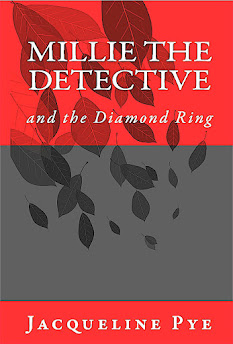
Since I've a few paperback copies left of Millie the Detective and the Diamond Ring with the original cover - the 12-year-old detective's first case - I'm offering five signed copies in a draw (UK only). This is it:

Readership is around 7+ to 11; the other main characters are Millie's younger brother and his best mate, as well as Badger the bully, and of course Boris the dog. Deadline is end of Tuesday December 8th.
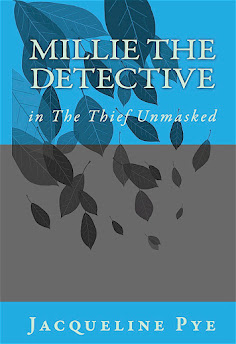
To enter (one entry per person), please provide the subtitle of Millie's second case (see the side of this page!) in one of these ways:
(a) tweet to @JacquelinePye
(b) message me on facebook (Jacqueline Pye)
(c) comment at the bottom of this blog with your name, and twitter or facebook
contact details if you have them.
Winners will be drawn randomly, and I'll post names on this blog shortly after the Tuesday, with a link to it on twitter and facebook.
Monday 30 November 2015
Winning Pieces of Flash Fiction - must there be a common strand?
My own submitted flash fictions have varied quite widely in their nature. Some have been quite dark - murder, other death, jealousy, obsession, weirdness, threat and so on, with several of these appearing in my collection Bottles and Pots. Others have veered towards the lighter and hopefully humorous. Guess which types have won or been placed more times?
As I enjoy writing and entering flash fiction, I do read a great number of others' entries, especially those longlisted, shortlisted or placed. What troubles me is that these - and this often applies to your actual short story winners - tend to be disturbing, stream of consciousness, surreal or generally depressing. Quite prepared to be contradicted; this is just my impression.
Wouldn't it be pleasing if, sometimes, lighter work and humour could be considered worthy? Guessing most of us study what's been winning before we submit, as is wise, but I'm imagining a tranche of flash fiction competitions that state the judges are looking towards fun/humorous skilful writing that manages to tell a story, show a snapshot, make a point, deliver a twist - or all of these.
This a bee in bonnet matter!
As I enjoy writing and entering flash fiction, I do read a great number of others' entries, especially those longlisted, shortlisted or placed. What troubles me is that these - and this often applies to your actual short story winners - tend to be disturbing, stream of consciousness, surreal or generally depressing. Quite prepared to be contradicted; this is just my impression.
Wouldn't it be pleasing if, sometimes, lighter work and humour could be considered worthy? Guessing most of us study what's been winning before we submit, as is wise, but I'm imagining a tranche of flash fiction competitions that state the judges are looking towards fun/humorous skilful writing that manages to tell a story, show a snapshot, make a point, deliver a twist - or all of these.
This a bee in bonnet matter!
Saturday 31 October 2015
October Round-Up: Ups and Downs
Further to the previous post, some things came off well, others less so ...
The Portswood Library centenary celebrations went very well, with some staff in vintage clothing, lots of exhibits, and the mayor cutting the cake. Penny Legg and I each did a short turn about our books; small audience with one chap rapidly falling asleep but the rest giving their attention.
Then Southampton's Festival of Words SOToSpeak15 began!
Authors on the water Southampton-Isle of Wight was entertaining, although my pitch in the family lounge was surrounded by very vocal preschoolers so a talk was not possible. Even so, had some very nice chats with children about reading and writing, and sold some books. The Solent was slightly choppy but not enough to bother us.
Very small audience at the Boutique Village, but even the children who were too young for my Millie the Detective books watched and listened as I hammed it up with the actions of the school bully and the fretting of the goodie characters. And again I sold books. Maybe should consider a late career on the stage instead.
The writing group of which I've been a member for about 6 years was given our own competition with prizes in each of the four categories. At a very lively awards ceremony in local bar/restaurant The Stage Door, I learned that I had come first in both of the categories entered - flash fiction and non-fiction. This was a shock, but very heartening as during the weeks beforehand I had seriously considered giving up writing. Some of the prize money will go towards raffle prizes to be won at our fab group Christmas tea at the Grand Harbour Hotel in Southampton.
The one-day writers' conference sadly had to be cancelled. I had collected loads of books and leaflets for our writing group trade stand, sorted them into categories, and made a plan of how the table would look. However, it was worse for those who were booked as speakers.
Made the longlist but not the shortlist for the Bath Flash Fiction Award, again honestly unexpectedly. This rolling award has just restarted, and I think it's worth entering again and working even harder this time.
So it's been quite a month, which also saw self-publication of Millie the Detective's second case, The Thief Unmasked. Details are at http://tinyurl.com/p4n7soq - a five-star review already - and info about the first book is not far away from that.
Happy November, all, whether or not your plunging into NaNoWriMo!
The Portswood Library centenary celebrations went very well, with some staff in vintage clothing, lots of exhibits, and the mayor cutting the cake. Penny Legg and I each did a short turn about our books; small audience with one chap rapidly falling asleep but the rest giving their attention.
Then Southampton's Festival of Words SOToSpeak15 began!
Authors on the water Southampton-Isle of Wight was entertaining, although my pitch in the family lounge was surrounded by very vocal preschoolers so a talk was not possible. Even so, had some very nice chats with children about reading and writing, and sold some books. The Solent was slightly choppy but not enough to bother us.
Very small audience at the Boutique Village, but even the children who were too young for my Millie the Detective books watched and listened as I hammed it up with the actions of the school bully and the fretting of the goodie characters. And again I sold books. Maybe should consider a late career on the stage instead.
The writing group of which I've been a member for about 6 years was given our own competition with prizes in each of the four categories. At a very lively awards ceremony in local bar/restaurant The Stage Door, I learned that I had come first in both of the categories entered - flash fiction and non-fiction. This was a shock, but very heartening as during the weeks beforehand I had seriously considered giving up writing. Some of the prize money will go towards raffle prizes to be won at our fab group Christmas tea at the Grand Harbour Hotel in Southampton.
The one-day writers' conference sadly had to be cancelled. I had collected loads of books and leaflets for our writing group trade stand, sorted them into categories, and made a plan of how the table would look. However, it was worse for those who were booked as speakers.
Made the longlist but not the shortlist for the Bath Flash Fiction Award, again honestly unexpectedly. This rolling award has just restarted, and I think it's worth entering again and working even harder this time.
So it's been quite a month, which also saw self-publication of Millie the Detective's second case, The Thief Unmasked. Details are at http://tinyurl.com/p4n7soq - a five-star review already - and info about the first book is not far away from that.
Happy November, all, whether or not your plunging into NaNoWriMo!
Subscribe to:
Posts (Atom)